
Promat

BIM PROMAT on YouTube
https://www.youtube.com/watch?v=QSQyyF9K1lM

NEWS!!!
Try out our new Dynamo script in Dynamo Player
EXPERTS IN PASSIVE FIRE PROTECTION AND HIGH-QUALITY INSULATION
!!! NEW BIM LIBRARIES FOR PROMADUKT 500 AND E600S
Don’t wait – download our new BIM libraries for ventilation and smoke extraction systems today. A file with shared parameters is included.
Now you’ll be able to design even more effectively. In our collections, as well as on our YouTube channel, you’ll find videos on how to design ventilation, along with a set of tips and tricks for Revit users.
We encourage you to watch the material
A solution for every fire safety or thermal challenge
All our solutions and systems are backed by over 60 years of experience and know-how. For every project, we can rely on our extensive, proven and certified range of calcium silicate materials, microporous and intumescent materials, and cementitious sprays. We assure you that we will always find the right solution for your fire or thermal insulation problem.

|

|
|
Construction Applications
|
Industry Markets
|

The PROMADUCT®-500 system – an innovative solution
The PROMADUCT®-500 system – an innovative solution – three-sided ventilation and smoke extraction ducts

Fire ventilation systems are a vital component of fire protection in commercial buildings. In protected rooms and escape routes, their purpose is to prevent the accumulation smoke from accumulating in quantities which, due to reduced visibility or toxicity, would prevent the safe evacuation of people, but would also endanger the safety of rescue teams. For this reason, it is so important to design fire ventilation and adapting it to the existing conditions in a given building, which in practice are often not exactly straightforward.
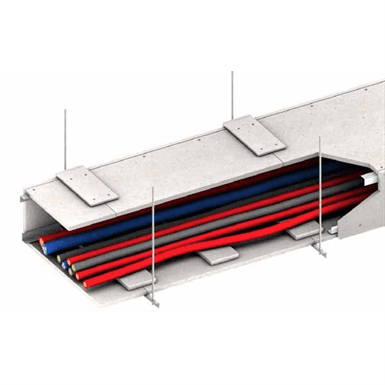
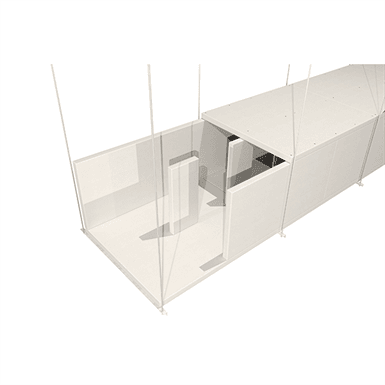
One of the problems, particularly in underground car parks, is limited space, and every centimetre of height that can be ‘saved’ in the room counts. This led to the idea to introduce a new solution – three-sided ventilation and smoke extraction ducts, where the fourth wall of the duct is formed by a solid ceiling (with a fire resistance rating no lower than that of the duct), but one that has been fully tested.
However, as there are no testing standards allowing for the testing of such ducts, the company Promat approached the Fire Research Department of the Building Research Institute with a request to develop a new test method. In this way, drawing on the vast knowledge and experience of the ITB Fire Research Department, it was possible to conduct non-standard fire tests, whilst still applying the criteria of test standards PN-EN 1366-1:2014 and PN-EN 1366-8:2006.
As a result, a solution was developed for three-sided horizontal ventilation ducts in the fire resistance class EI 120 (ho i↔o) S and three-sided smoke extraction ducts in the fire resistance class EI 120 (ho)S1500multi. In the case of smoke extraction ducts, this means that such ducts can extract smoke and hot combustion gases from smoke zones located in different fire compartments whilst maintaining the criteria fire integrity, fire insulation and smoke tightness in the event of a fire for a period of not less than 120 minutes, with an operating pressure range from +500 Pa to -1500 Pa. PROMADUCT ducts can pass through multiple fire zones, with a maximum cross-sectional area of 1.96 m² (2300 x 850 mm) – Fig. 1.
The design of the three-sided PROMADUCT®-500 ducts differs slightly from the four-sided version, as one of the duct walls is the ceiling. The vertical sides of the ducts, made of 50 mm thick PROMATECT®-L500 with a thickness of 50 mm are connected to the ceiling using steel angle brackets covered with a strip of PROMATECT®-L500 and fixed together to the ceiling with steel anchors. Additionally, a thin layer of mineral wool (max. 10 mm thick) is placed between the upper edge of the boards and the surface of the ceiling, a thin layer of mineral wool (max. 10 mm thick) is placed. (Fig. 2)

Fig. 1. Cross-sections of PROMADUCT®-500 ducts with a width of up to 125
If the ceiling surface is uneven, mineral wool may also be placed between the steel angle brackets and the ceiling (to level the substrate).
The three walls (two sides and the bottom) of the ducts are joined at the corners using steel fasteners (staples, screws or nails), and all panel joints (longitudinal and transverse) are sealed with Promat® K84, which ensures the necessary smoke-tightness at the joints. The joints of the vertical and horizontal sides may be offset from one another or may lie in the same plane. The locations of these joints are covered on the with strips of PROMATECT®-H boards 20 mm thick and at least 100 mm wide.
For PROMADUCT®-500 ducts wider than 1250 mm, additional stiffeners made of PROMATECT®-L500 boards are used, with a height equal to that of the duct and a width of at least 400 mm. The distance between these stiffeners is a maximum of 200 mm (Fig. 1).
Important note: the ducts do not require the suspension systems used for the four-sided versions, i.e. threaded rods and mounting rails are not used. This function is performed by steel angle brackets fixed to the ceiling; thanks to this solution, three-sided ducts take up a few centimetres less space.
Another advantage of this system is lower material consumption and thus lower material costs and lower labour costs; the result is a highly economical system. PROMADUCT®-500 ducts do not require compensators and do not deform during a fire.
Simplicity of installation, low cost and the availability of materials make the PROMADUCT®-500 system the ideal solution for designers, developers and contractors.
Would you like to know more?
Please contact our technical department
Did you know that...
Fire protection of load-bearing timber structures

Methods of fire protection for timber structures depend on selecting the most effective fire protection. First and foremost, they must be protected against the destructive effects of fire. This may involve:
- enclosing the structure (e.g. using fire-resistant plasterboard),
- non-reactive insulation (e.g. mineral wool).
- spray-applied fireproofing (can be applied to any shape),
- fire-retardant paint (a coating that swells when exposed to heat),
The fire resistance of a wooden element depends on its cross-section, shape, and the material from which it is made (type of wood: coniferous or deciduous, solid wood, glued, sawn, planed), the density of the wood, the availability of oxygen and the quantity and quality of the fire-retardant coatings applied. Depending on the above factors, PROMADUR® increases the fire resistance class of timber elements to 120 minutes (R120).
PROMADUR® is used to reduce the flammability of wooden surfaces. In accordance with PN-EN-13501, it is a non-flammable product, which represents the highest possible class for natural wood protected against fire through
a reactive coating.
PROMADUR® is a specialist fire-retardant coating used for the fire protection of wooden structures.
PROMADUR®
PROMADUR® can be used in all types of buildings, such as hotels, schools, offices, public buildings,
museums and libraries.
Its advantages include:
- high transparency (the wood grain remains visible after application);
- fire resistance up to class R120;
- it is a latest-generation reactive fire-retardant paint (activated by temperature
- intumescent paint) which reduces the flammability of wooden elements; the fire resistance of wooden load-bearing elements (columns, beams, ceilings and walls) is increased by applying just a single coat of PROMADUR®.