
Medium- and high-output condensing boilers
Everything you need to know about condensing boilers.
Condensing boilers – an efficient and economical heating solution.
Our wide range allows you to choose the boiler best suited to the needs of residents and buildings.
What is condensation?
Condensation is a physical phenomenon in which a gas turns into a liquid. In condensing boilers, in addition to the heat generated by the combustion of fuel (i.e. gas), a condensation process also takes place. Under the influence of high temperatures, the water vapour contained in the flue gases condenses on the walls of the heat exchanger. During the condensation process, energy is generated, which is additionally utilised by the boiler to operate more efficiently. Without condensation – as is the case, for example, in traditional boilers – the energy generated by the evaporation of the flue gases is expelled into the chimney and lost forever. This is why condensing boilers, although more expensive to buy, are significantly cheaper to run.
Types of condensing boilers
Boilers are generally divided into single-function and combi boilers. In all boilers, central heating is provided in the same way; the difference lies in how domestic hot water is produced.
In single-function boilers, the water in the central heating system is heated – that is, the water that flows on to the radiators or underfloor heating. For a single-function boiler to produce domestic hot water, the system requires a tank, i.e. a domestic hot water storage tank, in which the heated water will be stored. Single-function boilers are wall-mounted units with compact dimensions. However, if we also want to use the boiler to produce hot water, we will need to find space for the storage tank.
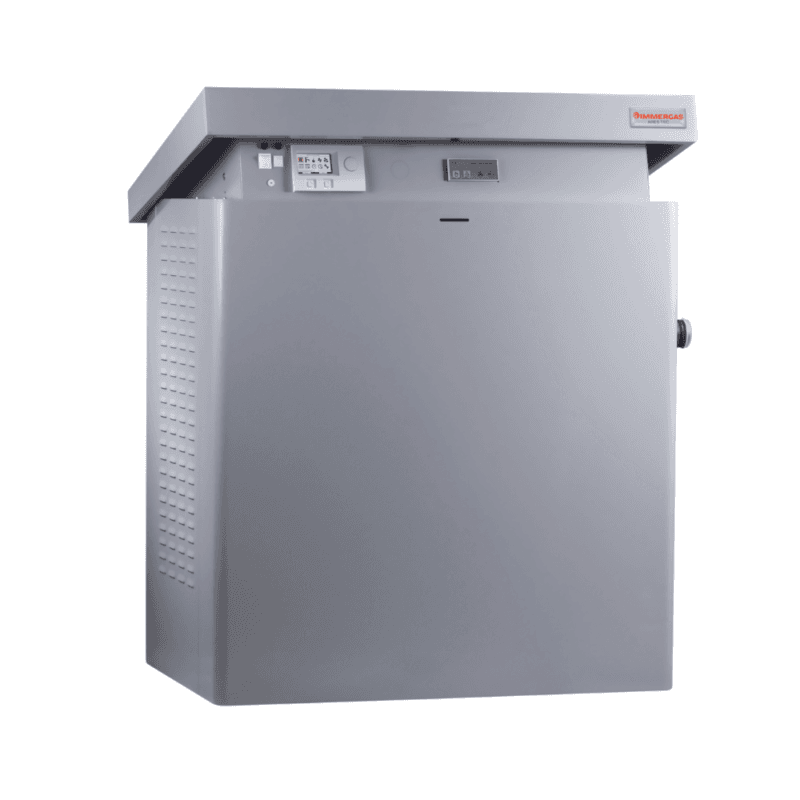
Combi boilers can be divided into two groups: instantaneous boilers and those with a built-in domestic hot water tank. Instant-flow boilers, as the name suggests, heat water on demand – that is, cold water from the plumbing system flows into the boiler, where it is heated, and then flows to the taps or showers. In combi boilers with a built-in DHW tank, there is no need for a separate tank, as this is already integrated into the boiler. Combi boilers can be further divided into wall-mounted and floor-standing models. This is determined by the appliance’s heating capacity or the size of the built-in tank. Boilers with tanks up to 54 litres in capacity are wall-mounted; above this capacity, we are dealing with floor-standing boilers, which resemble a fridge in appearance.
Product groups
No results for the given criteria