


Drywall systems – Suspended plasterboard ceilings
Self-supporting ceilings
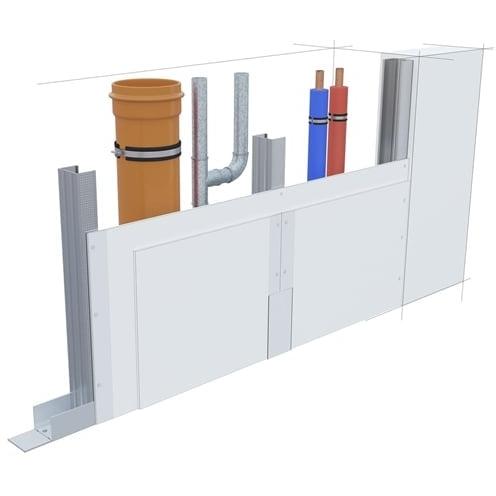
Modern commercial buildings are equipped with increasingly advanced technologies designed to enhance user comfort – such as a range of complex ventilation, air-conditioning and central heating systems. Such buildings are also criss-crossed with power supply cables and digital systems to ensure the proper functioning of organisations, which nowadays are heavily reliant on computers.
As a result, designers of commercial buildings face a considerable challenge – they must find a way to neatly accommodate all these complex systems whilst maintaining the building’s architectural integrity and ensuring it remains fully functional.
These runs are mainly located in corridors, from which the individual systems are distributed to specific rooms. However, due to the large number of conduits, it is not always possible to use standard suspended ceilings, which serve to conceal these installations aesthetically. The reason is simple: there is not enough space to install the hangers required to suspend standard structural systems for fitting plasterboard. Siniat has, however, found a solution to this.
Or even: two solutions.
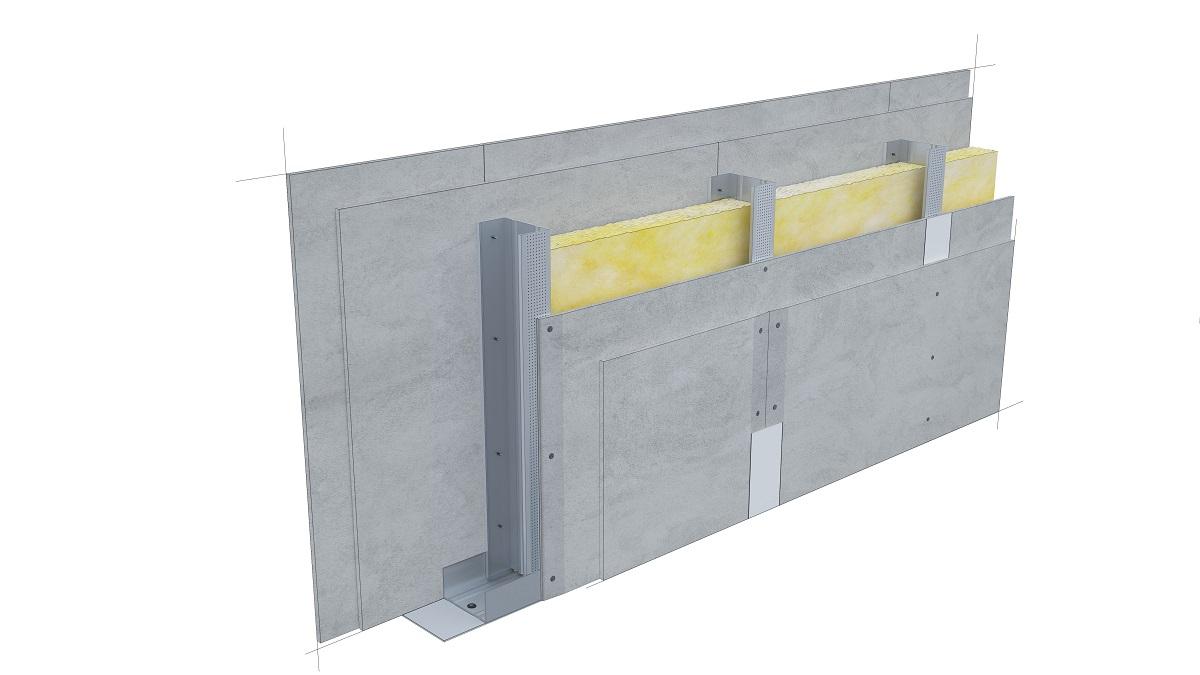
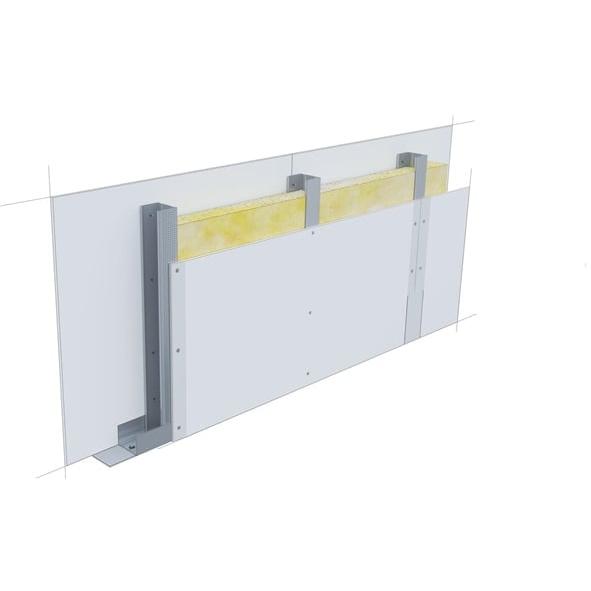
First, we developed innovative suspended ceilings without the use of suspension cables, using only the walls separating the circulation routes. We carried out rigorous mechanical tests, confirming the highest level of safety in the use of this solution. The next step was to subject these ceilings to fire resistance tests under fire exposure from below (a←b) and to classify them in accordance with standard EN 13501 across the full range of classes EI30 to EI120. This is how modern hangar-free solutions, i.e. Siniat self-supporting (span) ceilings, were created.
However, that was not the end of the work. Designers and fire safety experts analysed the complex installation systems, which were concentrated in a small area, and issued a clear opinion stating that such installations could contribute to the outbreak and spread of fires. Consequently, in order to ensure an adequate level of fire safety, it became necessary to develop a new generation of self-supporting ceiling systems – with fire resistance from above (a→b) and fire resistance on both sides (a↔b).
The specialists at Siniat have also risen to this challenge with flying colours. We have developed unique self-supporting ceiling systems with fire resistance when exposed to fire from both sides, in the EI60 to EI180 class range. The development and issuance, based on Preliminary Type Testing (ITT), as well as the CE marking, ensuring the solutions can be used throughout the European Union.
These are precisely the systems we would like to present to you and your company as a response to the new, stringent fire safety regulations.
Take a look at our Siniat Technical Catalogue
Suspended ceilings
CONSTRUCTION OF A TWO-LEVEL CROSS-BEAM SUSPENDED CEILING
A cross-beam suspended ceiling made of plasterboard is a solution that allows for an impressive ceiling finish in any interior. Currently, installing a ceiling on a single-level framework is very popular. However, for clients seeking a more interesting visual effect, we recommend a solution based on a two-level structure. We invite you to read the information on installing a two-level suspended ceiling based on a cross-shaped structure.
The suspended ceiling system, mounted on a two-level cross-braced structure, consists of:
- plasterboard cladding
- grating
- suspension elements
Plasterboard cladding in a two-level suspended ceiling
One of the most common mistakes made when installing a suspended ceiling is choosing the wrong type of panelling. Plasterboard panelling should be selected according to the requirements placed on the ceiling. These may include requirements regarding: fire resistance, sound insulation, resistance to water and mould, and impact resistance.
Here’s a tip!
If the installation of a two-level suspended ceiling is carried out:
- in rooms where the relative humidity does not exceed 70%, Nida Expert plasterboard is sufficient
- in rooms where the relative humidity does not exceed 85% (for up to 10 hours at a time), Nida Woda plasterboards are sufficient
- in rooms where there are requirements regarding resistance to water and mould, Nida Hydro plasterboards should be used
- in interiors subject to fire safety requirements, it is recommended to use Nida Ogień Plus boards
- in buildings where increased impact resistance is required, Nida Twarda boards
You can find more information about the panels offered by Siniat and their use in cross-suspended ceiling constructions and other applications here.
GRID IN A TWO-LEVEL CROSS-VENTILATED SUSPENDED CEILING
Figure 1. Suspended ceiling on a two-level cross-shaped supporting structure – axonometric view (Description: 1 – Nida 12.5 mm plasterboard, 2 – Nida CD60 bottom support profile, 3 – Nida CD60 top main profile, 4 – Suspension element, 5 – Nida LK60 cross connector)
The grid for two-level ceilings consists of a lower and an upper level. The lower level is formed by the Nida CD 60 lower load-bearing profile, to which the plasterboard cladding panels are fixed directly. The maximum spacing between load-bearing profiles is 400 mm.
The top level consists of Nida CD 60 main top profiles. Their spacing depends on the number of plasterboard panels and any additional load, such as mineral wool.
The lower support profile and upper main profile of the Nida CD 60 are positioned perpendicular to each other and connected using special Nida LK 60 cross connectors.
Important!
When constructing the grid for a two-level suspended ceiling, factors such as the positioning of expansion joints in the gypsum board claddingand any expansion joints in the building structure, the presence of access hatches, various types of light fittings, and ventilation or electrical installations.
Acoustic ceilings
1438819-full
1438821-full
1438820-full