


Floor drains
All floor drains and floor inspection hatches are manufactured as standard from stainless steel: AISI 304, EN 1.4301 and AISI 316L, EN 1.4404. The type of drain (horizontal or vertical) depends on the volume of liquid (medium) to be drained and on structural parameters (e.g. floor thickness).
The flanges are made from sheet metal of a thickness appropriate to the specific type of flange. All components are welded in an argon atmosphere and then pickled and passivated, ensuring high-quality welds.
ADVANTAGES OF STAINLESS STEEL DRAINS
- choice of grating depending on the application and load class,
- easy installation,
- thanks to the siphon’s design, each drain also serves as an access point to the sewer system,
- simple design,
- easy to keep clean.
DESCRIPTION OF THE INDIVIDUAL COMPONENTS
OF VERTICAL AND HORIZONTAL FLOOR DRAINS
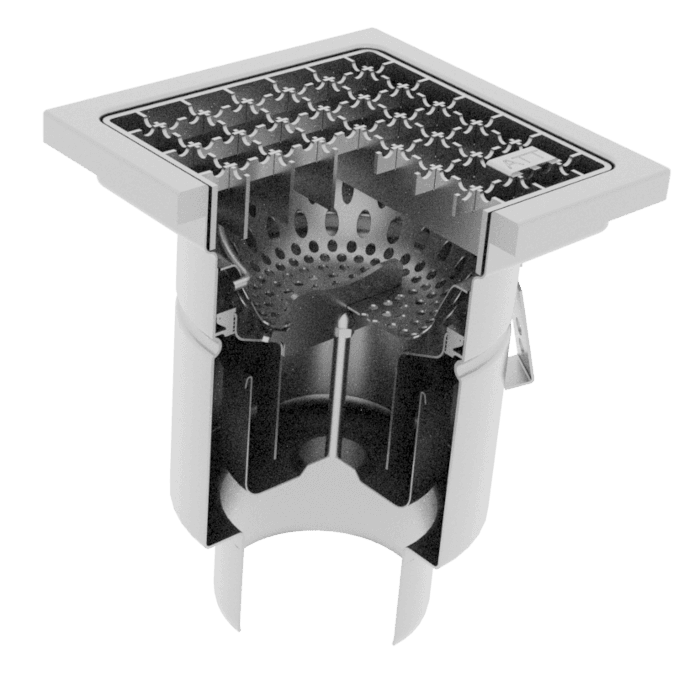
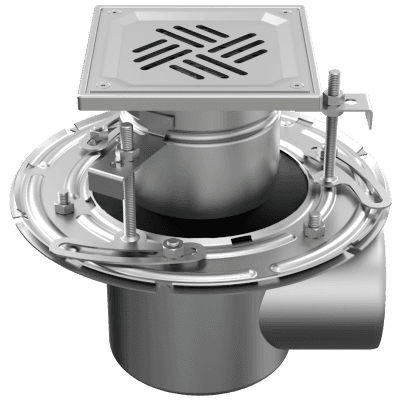
- Bodies – the round shape minimises the accumulation of dirt and ensures it can be easily removed. Welded joints are properly ground to eliminate sharp edges. This prevents the risk of injury during installation or cleaning.
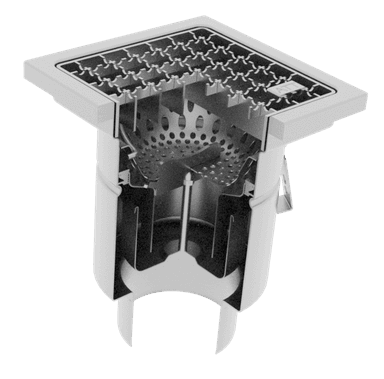
- Grates – available in various shapes, sizes and finishes. We select grates based on the load class and the installation location of the drain. We offer the following types of grates: mesh – non-slip, ladder, plate and sheet metal – perforated.
- Sedimentation baskets – their use is recommended where there are large quantities of solid contaminants in the effluent.
- Strainers – used where there are small amounts of solid contaminants.
- Traps – characterised by high functionality and ease of use. They provide easy access to the sewer pipe, quick cleaning and the ability to check the system for leaks.
SELECTION OF
DRAINS Drains are selected on the basis of two key parameters:
- The volume of wastewater discharged (selection of the appropriate drain diameter, expected flow rate [l/s] and size of the top section).
- The size, type and intensity of the load (the load-bearing element is a grating which, depending on its type and height, will support the specified load).
How to install floor drains?
INSTALLATION OF ONE-PIECE DRAINS
- The drain connection must be installed at the correct height.
- Place the drain in the socket of the drainpipe so that the top of the drain is 1–2 mm below the top layer of the floor.
- Fill the space with concrete.
- When concreting, care must be taken not to restrict the top opening of the drain; it is also important to ensure that hard-to-reach areas are thoroughly filled with concrete.
FITTING OF TWO-PART DRAIN COVERS
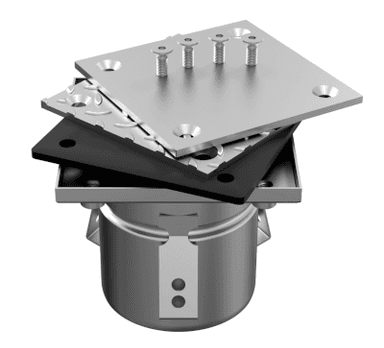
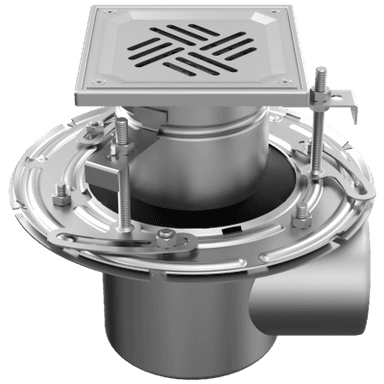
- We begin the installation by embedding the lower part of the drain into the structural layers of the ceiling. The lower part should be embedded in a recess of 15–20 [mm] to ensure that condensation from the horizontal waterproofing drains properly into the drain.
- We install the damp-proof course for the ceiling and secure it using the lower section’s clamping ring.
- The next step is to position and level the upper part of the drain at the specified elevation. The top edge of the drain should be 1–2 [mm] below the floor surface.
- Once the upper part has been stabilised, you can proceed with the remaining floor layers.
- Fill the space with concrete.
- When concreting, ensure that the top opening of the drain is not narrowed; also remember to fill hard-to-reach areas thoroughly with concrete.
https://att.eu/produkty/wpusty-profesjonalne-podlogowe-posadzkowe/
Wait, we have more of that
Photos
wpusty-profesjonalne-podlogowe-posadzkowe-1
wpusty-profesjonalne-podlogowe-posadzkowe-2
wpusty-profesjonalne-podlogowe-posadzkowe-3