


SPLIT-TYPE HEAT PUMPS
Split-type air-source heat pumps
What is a split-type heat pump?
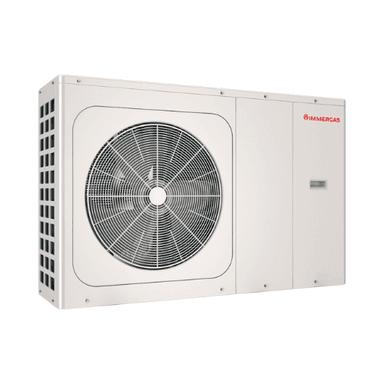
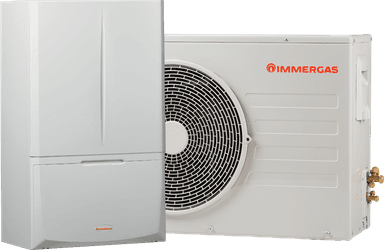
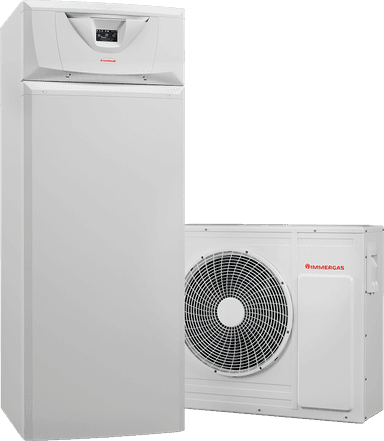
Split-type heat pumps consist of two separate units – an indoor unit and an outdoor unit. The indoor unit contains hydraulic components such as an expansion tank, a plate heat exchanger and a circulation pump, whilst the outdoor unit contains refrigeration system components such as an evaporator, an expansion valve and a compressor.
As the name suggests, the indoor unit is installed inside the building, and the outdoor unit outside. Both parts of the system are connected by pipes that carry the refrigerant between them.
The split-type pump in the Immergas range comprises pumps from the Magis PRO V2 series, with power ratings ranging from 4 to 16 kW.
Split heat pump – how it works
As a general rule, all air-to-water heat pumps operate in the same way – split systems differ from them only in their design. The unit draws aerothermal energy, i.e. energy from the outside air, which is heated by solar radiation.
The split heat pump units are connected by refrigerant pipes through which R32 or R410a refrigerant flows. This refrigerant has the property of evaporating at lower temperatures, which eliminates the risk of freezing during winter and damage to the heat pump.
When the unit is running, it extracts heat from the outside air. The air flows through the evaporator, where it transfers energy to the refrigerant circulating between the units. The cooled air leaves the system. At the same time, the refrigerant is heated to its boiling point and changes to a gaseous state, but it is not yet very hot, as the refrigerant’s boiling point is very low.
The gas is then fed into the compressor, which is powered by electricity. This causes the pressure and temperature of the gas to rise rapidly. The hot refrigerant enters the condenser, a heat transfer device that supplies heat to the building’s heating system, specifically to the water circulating within it, causing its temperature to rise. Thanks to the circulation pump, the hot water transfers heat to the radiators, underfloor heating or the hot water
tank. As the refrigerant releases heat in the condenser, its temperature drops, returning to its original liquid state. It then flows to the expansion valve, where the pressure and temperature are reduced, before finally returning to the evaporator – the first component of the entire cycle – and the whole process begins again.